
QUITO
It is the First Cultural Heritage of Humanity.
It has the largest and best-preserved Historic Center in America.
It offers unique spaces such as monasteries, convents, museums, internal courtyards and squares.
It is the heart of business in the Middle of the World.
It is the junction and transit point between North and South America.
It is one of the top 10 destinations in Latin America and the Caribbean.
It is the gateway to the four worlds of Ecuador, the Galapagos, the Pacific Coast, the Andes, and the Amazon.
It has an important physical, technological and service infrastructure of international standards.
With its New International Airport, it is a very accessible destination.
A tour of the capital of Ecuador takes you from the Andes to the subtropics: this is undoubtedly the city of diversity, in cultural expressions, as well as in natural wonders. It has the largest and best-preserved historic center in Latin America, is the highest capital in the world (2,850 m high) and sits on the slopes of the Pichincha volcano.
QUITO IS UNIQUE
Much of Quito’s uniqueness is due to the geography that the Andes gives, which is more present here than in neighboring capitals, you can see snow-capped peaks at any distance! Quito shares an Inca legacy with Peru, but the Incas only conquered the millennial conglomerate of native lordships 50 years before the arrival of the Spanish. The culture of Quito – and Ecuador in general – is therefore very diverse and multifaceted.
The Quito area was one of the last places to be conquered by the Incas and the city, one of the first Spanish foundations in South America.
World Heritage Site. The most important concentration of churches, chapels, squares, museums and colonial buildings in South America have made Quito the first city to be declared a World Heritage Site by UNESCO, in 1978.

Currency
The official currency in Ecuador since 2000 is the United States dollar; the previous currency was Sucre and the exchange rate was frozen at $ 25,000 sucres per dollar. Many restaurants, shops, and commercial stores receive debit and credit cards, but some businesses use only cash.

Security
The altitude of Quito and its surroundings varies between 500m, 2,850m and 4,100m (1,640, 9,350 and 13,451 feet). For outdoor activities a doctor should be consulted for heart conditions that the traveler may have. Most of the world’s population lives at sea level, so consider the effects of altitude for your visit.

Technology
Many squares and public parks have WIFI access. Most hotels, hostels and restaurants offer free access to this service.

What to bring
Bring as little as possible, but some things are necessary: sunscreen, a hat, walking shoes, a camera, insect repellent, an umbrella and always carry a sweater. The sun is strong, especially between 10 a.m. and 2 p.m. It is recommended to apply sunscreen every two hours (or at least once a day!) And 30 minutes before leaving the hotel.

Weather
For a city situated between the Tropics of Cancer and Capricorn, its perfect temperate climate is hard to believe, and is only possible thanks to the way the city rises above sea level, in a pleasant inter-Andean valley in the middle of imposing volcanoes.
During the summer, the temperature varies from 14 °C to 24 °C (57 °F to 75 °F), it is a dry and windy season and runs from June to September. Winter begins in October and is characterized by afternoon rains, in that period the temperature ranges from 8 °C to 15 °C (46 °F to 59 °F). In the evenings and nights, the temperature always drops and it can rain.
It’s unpredictable. Quiteños say they experience the four seasons in a single day (hot sun and cold rain), so we recommend that you wear several items of clothing. Have a jacket and coat on hand to wear and remove in a matter of hours. It usually rains unexpectedly just as the sun returns in the late afternoon.
10 REASONS TO VISIT QUITO
Why visit Quito? There is no single reason, there are several reasons why Quito is considered one of South America’s Leading Destinations and one of the Best Destinations to Discover.
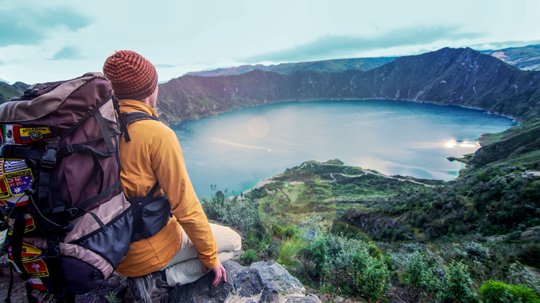
Quito in the middle of the world
This is the closest capital to the sun at 2,850 meters above sea level and is also the only place where you can set one foot in the Northern Hemisphere and another in the Southern Hemisphere. You will be able to experience the pure energy of the “Center of the World” as you walk along the equatorial line, imaginatively drawn by the Geodesic Mission when it determined the point of Latitude 0°0’0’’. This privileged geographical location gives Quito an excess of virtues that are evident in its spring climate, all year round, and its amazing natural wealth.
Quito in the middle of the world
This is the closest capital to the sun at 2,850 meters above sea level and is also the only place where you can set one foot in the Northern Hemisphere and another in the Southern Hemisphere. You will be able to experience the pure energy of the “Center of the World” as you walk along the equatorial line, imaginatively drawn by the Geodesic Mission when it determined the point of Latitude 0°0’0’’. This privileged geographical location gives Quito an excess of virtues that are evident in its spring climate, all year round, and its amazing natural wealth.
A Historical Center without equal in the world
Discover one of the largest and best-preserved colonial sites in America and the urban jewel that motivated the declaration of the First Cultural Heritage of Humanity. In this place, you will find the history of the city in its many “must-sees”: The Company of Jesus, a masterpiece of the Baroque in America; the Plaza Grande, the nucleus of important historical feats that narrate the history of Quito, the country and the continent; tour the religious complex of San Francisco; also stroll through La Ronda, a street that keeps its charm with old workshops and traditional crafts that are still alive.
The Historic Center is not a great museum. It is dynamic and beautiful, a lively place that converges the daily life of its inhabitants, merchants, religious devotees, tourists, public officials and many more.
A Historical Center without equal in the world
Discover one of the largest and best-preserved colonial sites in America and the urban jewel that motivated the declaration of the First Cultural Heritage of Humanity. In this place, you will find the history of the city in its many “must-sees”: The Company of Jesus, a masterpiece of the Baroque in America; the Plaza Grande, the nucleus of important historical feats that narrate the history of Quito, the country and the continent; tour the religious complex of San Francisco; also stroll through La Ronda, a street that keeps its charm with old workshops and traditional crafts that are still alive.
The Historic Center is not a great museum. It is dynamic and beautiful, a lively place that converges the daily life of its inhabitants, merchants, religious devotees, tourists, public officials and many more.
Quito cuisine
The flavors of Quito’s cuisine are one of the best kept secrets in the city. They deserve to be tasted by every good traveler, traditional mestizo dishes that mix the pre-Columbian and the colonial, have a strong influence both Andean and Iberian: “locro”, “fritada”, “empanadas”, wraps, chili sauces, “paila” ice cream are just some of the classic dishes of this city. Your visit will not be complete without savoring the offer of chocolates made with fine aroma cocoa, the best in the world, of course high-altitude coffee, produced in Ecuador.
And do not forget to enjoy fresh fruits throughout the year: some unique ones that you will only find in our markets, do not miss the tree tomato, the naranjilla, the custard apple, the granadilla and the “taxo”, the “babaco” and much more.
With the arrival of the Franciscan order, five centuries ago, the ear of barley also arrived in half of the world. Currently this drink of malts and different textures has its space in several establishments that make craft beer.
Quito cuisine
The flavors of Quito’s cuisine are one of the best kept secrets in the city. They deserve to be tasted by every good traveler, traditional mestizo dishes that mix the pre-Columbian and the colonial, have a strong influence both Andean and Iberian: “locro”, “fritada”, “empanadas”, wraps, chili sauces, “paila” ice cream are just some of the classic dishes of this city. Your visit will not be complete without savoring the offer of chocolates made with fine aroma cocoa, the best in the world, of course high-altitude coffee, produced in Ecuador.
And do not forget to enjoy fresh fruits throughout the year: some unique ones that you will only find in our markets, do not miss the tree tomato, the naranjilla, the custard apple, the granadilla and the “taxo”, the “babaco” and much more.
With the arrival of the Franciscan order, five centuries ago, the ear of barley also arrived in half of the world. Currently this drink of malts and different textures has its space in several establishments that make craft beer.
Crafts and art
Quito in colonial times was a very important cultural and artistic center. This virtue has been preserved throughout the ages. Now, in the middle of the republican era, it is common to meet artisans who keep centuries-old trades: waxworkers, chest of drawers, hatters, tailors, herbalists still keep their knowledge and display them in their workshops, most of which are located in the Historic Center.
During the colonial period, Quito was one of the cities that most promoted religious arts, and its well-known Quito School produced some of the most important colonial artists in America, including the sculptors Bernardo de Legarda and Manuel Chili “Caspicara” and the painter Miguel de Santiago, works that you can discover in the many museums and churches of Quito.
Crafts and art
Quito in colonial times was a very important cultural and artistic center. This virtue has been preserved throughout the ages. Now, in the middle of the republican era, it is common to meet artisans who keep centuries-old trades: waxworkers, chest of drawers, hatters, tailors, herbalists still keep their knowledge and display them in their workshops, most of which are located in the Historic Center.
During the colonial period, Quito was one of the cities that most promoted religious arts, and its well-known Quito School produced some of the most important colonial artists in America, including the sculptors Bernardo de Legarda and Manuel Chili “Caspicara” and the painter Miguel de Santiago, works that you can discover in the many museums and churches of Quito.
Our museums, theaters and cultural centers
Quito has a large number of places that tell stories and realities of other times, as well as where culture is promoted through permanent and temporary exhibitions, theater, music or cinema functions. The Museum of the City, the Casa de El Alabado Museum (with an extraordinary display of pre-Columbian art), the Wax Museum (Alberto Mena Caamano), the Sucre Theater, the Center for Contemporary Art, the House of Music are some of the most important.
Discover Quito’s archeology at site museums in Tulipe, Rumipamba or La Florida, which tell the fabulous story that preceded the arrival of the Spanish.
Children also have their spaces in Yaku Park Museum, the Interactive Science Museum and the Train Museum.
Our museums, theaters and cultural centers
Quito has a large number of places that tell stories and realities of other times, as well as where culture is promoted through permanent and temporary exhibitions, theater, music or cinema functions. The Museum of the City, the Casa de El Alabado Museum (with an extraordinary display of pre-Columbian art), the Wax Museum (Alberto Mena Caamano), the Sucre Theater, the Center for Contemporary Art, the House of Music are some of the most important.
Discover Quito’s archeology at site museums in Tulipe, Rumipamba or La Florida, which tell the fabulous story that preceded the arrival of the Spanish.
Children also have their spaces in Yaku Park Museum, the Interactive Science Museum and the Train Museum.
At night
There are several options in restaurants, cafes, bars and discos in the neighborhoods of La Mariscal, La Floresta, Guápulo and La Carolina. There you will find music, local and international gastronomy, party and, above all, the singular joy of Quito!
At night
There are several options in restaurants, cafes, bars and discos in the neighborhoods of La Mariscal, La Floresta, Guápulo and La Carolina. There you will find music, local and international gastronomy, party and, above all, the singular joy of Quito!
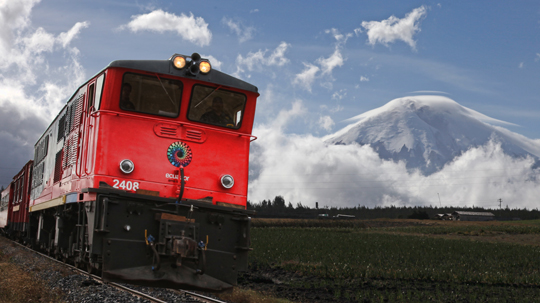
Get on the rail
From the popular Chimbacalle neighborhood in Quito, embark on a journey on “the world’s most difficult railway”, which has now become a heritage tourist train, linking the Coast with the Andes, through an impressive engineering work from the early twentieth century. Today you can visit the Andean and coastal landscapes on the train.
Get on the rail
From the popular Chimbacalle neighborhood in Quito, embark on a journey on “the world’s most difficult railway”, which has now become a heritage tourist train, linking the Coast with the Andes, through an impressive engineering work from the early twentieth century. Today you can visit the Andean and coastal landscapes on the train.
Shopping
One of the leisure activities is shopping and in Quito you will find a diversity of options for all tastes and budgets. From modern shopping centers such as Quicentro Shopping or Mall El Jardín with local and international brands, or Ecuadorian contemporary design stores in the La Floresta or La Mariscal neighborhood; also, in the Historic Center you can take a look at specialized craft stores such as El Quinde, which offers Andean items, from instruments to fine alpaca fabrics, clothing, jewelry in gold, silver, filigree, leather items and more.
The products and the fabulous Ecuadorian raw material, which includes the best chocolate in the world, excellent shade grown coffee, the only vegetable ivory (the tagua) and the famous toquilla straw hats that the entire world knew as Panama Hats, are some of the products that you can take as a souvenir.
Quito is also the ideal destination to buy art: in El Ejido you will find paintings, sculptures, oil paintings, etc. And in La Mariscal it is the proper place for galleries and antique dealers.
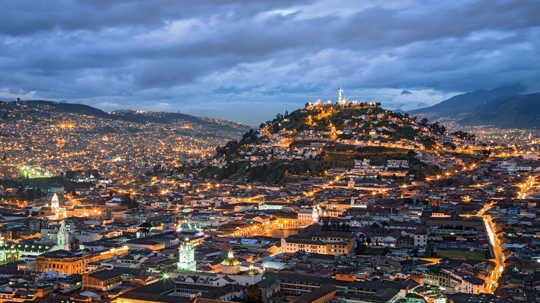
Shopping
One of the leisure activities is shopping and in Quito you will find a diversity of options for all tastes and budgets. From modern shopping centers such as Quicentro Shopping or Mall El Jardín with local and international brands, or Ecuadorian contemporary design stores in the La Floresta or La Mariscal neighborhood; also, in the Historic Center you can take a look at specialized craft stores such as El Quinde, which offers Andean items, from instruments to fine alpaca fabrics, clothing, jewelry in gold, silver, filigree, leather items and more.
The products and the fabulous Ecuadorian raw material, which includes the best chocolate in the world, excellent shade grown coffee, the only vegetable ivory (the tagua) and the famous toquilla straw hats that the entire world knew as Panama Hats, are some of the products that you can take as a souvenir.
Quito is also the ideal destination to buy art: in El Ejido you will find paintings, sculptures, oil paintings, etc. And in La Mariscal it is the proper place for galleries and antique dealers.
Near everything
Quito as a gateway to Ecuador is strategically located to get closer to the Pacific Coast with its beaches, fishing villages and rich gastronomy; the Andes with its Avenue of the Volcanoes that dazzled the German expeditionary Humboldt; the Amazon with all its green magic and extraordinary natural diversity; the Galapagos Islands, unique in the world, that narrate, live and direct, the evolution of species, a theory formulated in them by the renowned naturalist Charles Darwin. Quito is your starting point.
Near everything
Quito as a gateway to Ecuador is strategically located to get closer to the Pacific Coast with its beaches, fishing villages and rich gastronomy; the Andes with its Avenue of the Volcanoes that dazzled the German expeditionary Humboldt; the Amazon with all its green magic and extraordinary natural diversity; the Galapagos Islands, unique in the world, that narrate, live and direct, the evolution of species, a theory formulated in them by the renowned naturalist Charles Darwin. Quito is your starting point.
Personal security
Just like in any other country, it is important to be careful. Keep your belongings with you at all times. When you get on a bus or in crowded areas, keep your bag in front of you. Do not leave your wallet or cell phone in the back pocket. Avoid walking alone in parks or on the street at night where there is no lighting.
TRANSPORT
From/to the airport, the cost is USD 68.- Private transfer, capacity, up to 2 people with moderate luggage.
Distance from the airport, about 40 km.
The transfer takes approximately 45 minutes. Take the time and day of the week into account to anticipate your return.
Inside the city
There are three metropolitan public transport systems that cover most of the city from north to south: the trolleybus, the ecovia and the north-western corridor. There are also private lines throughout the city. The ticket costs $ 0.25 ctvs. for adults and $ 0.12 ctvs. for children and the elderly.
Commuter trains – parishes
Inter-parish buses are painted green, the cost of the ticket depends on the destination you go to.
Taxis
If you take a taxi, the minimum fare during the day is $ 1.50, at night it increases to $ 1.75 ctvs. Always demand the use of a meter, it is better to call from the hotel or from wherever you are, than to wait in the street. You can also use applications like EasyTaxi, mitaxi JJ, Cabify, Uber.
Public bicycle
Connects the center and the north of the city through a network of cycle routes, check out www.biciquito.gob.ec
THE CHURCH OF THE SOCIETY OF JESUS
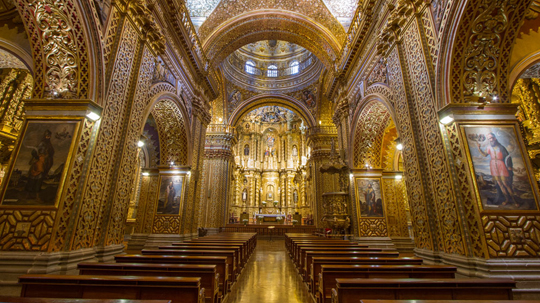
The Church of the Society of Jesus of Quito, a living example of art and faith of the Ecuadorian people, maximum expression of the Baroque style in Ecuador, was built from 1605 to 1765.
They were foreign Jesuit priests among them, Marcos Guerra, Jorge Vinterer, Leonardo Deubler, Venancio Gandolfi and Hernando de la Cruz, skilled in different arts and crafts: architecture, carving, sculpture and painting, who gave shape and unique style to the Jesuit temple. The two large original canvases of Hell and the Last Judgment are attributed to Hernando de La Cruz’s brush, works executed in 1620, whose facsimiles today as yesterday are located at the north and south ends of the church’s narthex. Colonial Quito also contributed with great architects who covered the church with gold and magnificent paintings, artists such as Nicolás Xavier Goribar, Bernardo de Legarda, Antonio Salas, and the unique anonymous workforce of those who named the Escuela Quiteña and left their mark on the lush decoration of the temple.
SAN FRANCISCO CONVENT
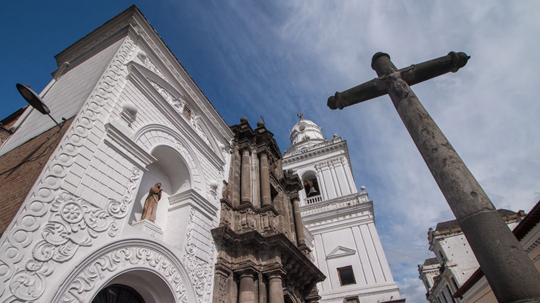
Monday to Saturday, from 7:30 a.m. to 12:30 p.m. and from 2:30 to 5:30 pm. Sundays: from 7:00 a.m. to 12:00 p.m.
Cuenca 477 and Sucre
There is no visit to Quito that can ignore this religious complex, one of the most important on the continent.
There are more than three hectares (about 40,000 m2) of temples (one major church and two minor ones), cloisters, courtyards, chapels, rooms; not counting the orchard, the ossuary, the catacombs. The religious labyrinth of San Francisco unites the city’s past with the soul and life of the Quiteño who knows it, travels and occupies it every day.